
What AI-first development means
Using an assistant to write code does not change the development process by itself. The team still has to decide what behavior it wants, state the constraints, review the implementation and check the result.
AI-first development adapts that loop to a concrete reality: a growing part of implementation is produced by agents that do not retain stable product memory. Context, intent and evidence therefore have to exist outside each session and travel with the work.
The unit of work is no longer only a diff. It includes the reason for the change, the contract it must satisfy, the resulting code and the proof captured during verification.
The framework artifacts
An AI-first workflow needs a small set of connected parts:
- Product evidence: observations, data or conversations that establish a need.
- Decision: the selected option, rejected alternatives and their rationale.
- Specification: expected behavior, constraints and acceptance criteria.
- Code context: affected components, dependencies, interfaces and invariants.
- Execution: tasks and changes produced by people or agents.
- Verification: tests, logs, screenshots or other proof tied to the contract version.
The value is not document volume. It is the ability to follow the links: from a line of code to the decision that authorized it, and from a criterion to the evidence that shows whether it is satisfied.
The operating loop
Define
The team turns a need into a testable contract. Before execution, it separates facts from hypotheses, records open decisions and writes criteria that distinguish a correct result from a plausible one.
Spec-driven development covers this part in more detail.
Prepare context
The task receives only relevant context: repository rules, affected architecture, interfaces, current decisions and necessary examples. More context is not always better; it needs provenance and a current version.
Execute
The agent implements against the contract. If it discovers a new constraint or needs to change a shared interface, that information returns to the contract instead of remaining inside the agent conversation.
Verify
The output is checked with reproducible evidence. A message saying “tests pass” is status; the run, logs and criteria version form the proof. The guide to verifying AI-generated code develops this distinction.
Learn
The result updates product knowledge. A hypothesis may be confirmed or rejected, a decision may change, and a specification may become stale. The system should show those revisions without erasing provenance.
Architecture and patterns
The framework does not mandate one architecture. A small product may keep context inside a monolith. A system with several sources and models may separate ingestion, storage and retrieval. A high-risk domain may require human review before execution or release.
The choice depends on volume, data sensitivity, latency, the cost of an incorrect output and the team’s operational capacity. The comparison of architecture patterns for AI systems explains those trade-offs.
Context injection
Context injection gives an agent the rules and artifacts it needs at execution time. It is not a matter of pasting all documentation into a prompt. It selects context for the task and retains the provenance of each item.
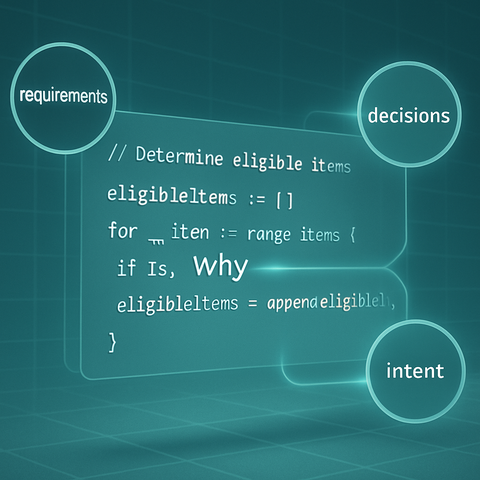
A useful implementation answers these questions:
- Which rule or decision does this task need?
- Where did it come from and when was it updated?
- What happens when two sources conflict?
- How is a constraint discovered during execution recorded?
Responsible use
The same trail that supports maintenance also supports AI governance. Teams should record data sources and model versions, restrict access to sensitive information, evaluate domain-relevant bias and define who approves high-impact decisions.
Before automating a decision, the team should be able to state who it affects, which data it uses, how an output is reviewed and which mechanism can stop or correct the system. These questions belong in the contract rather than a later review.
What the framework does not solve
The method does not turn a hypothesis into evidence, guarantee that a specification is correct or remove the need for human judgment. It also cannot compensate for a repository without clear boundaries or a test suite that does not observe important behavior.
Its job is narrower: keep the reason, decision, execution and verification connected so a team can review and change the product without reconstructing its history during every iteration.
Frequently asked questions
What is AI-first development?
It is an approach where context, intent and evidence are first-class artifacts alongside code. The goal is not to generate more output; it is to maintain a contract that people and agents can execute and verify.
How is it different from using an AI coding tool?
A tool accelerates an implementation session. A framework organizes the full loop: how a decision is made, which context an agent receives, how its output is validated and how learning returns to the product.
What does a team need to start?
A small testable contract, repository rules, a way to provide task-specific context and reproducible evidence at completion. Additional complexity is justified only after those basic parts work.